The Village of Aldie

Aldie enjoys a rich, 200+ year heritage. The village grew up in the early 1800s around the Aldie Mill, a merchant grain mill completed in 1809 and powered by twin overshot water wheels—Virginia's only known gristmill of this type.

The village sits at a strategic gap in the Bull Run Mountains, at the intersection of three historic turnpikes:

This crossroads location made Aldie a center of commerce and travel in the 19th century. The village was chartered by the Virginia General Assembly in 1810. Its name comes from Aldie Castle, the Scottish ancestral home of Charles Fenton Mercer, who financed the mill's construction.

Today, the village has a designated historic district with buildings dating from as early as 1775. Walking through Aldie is like stepping back in time—stone walls, historic homes, and the enduring presence of the Mill itself.

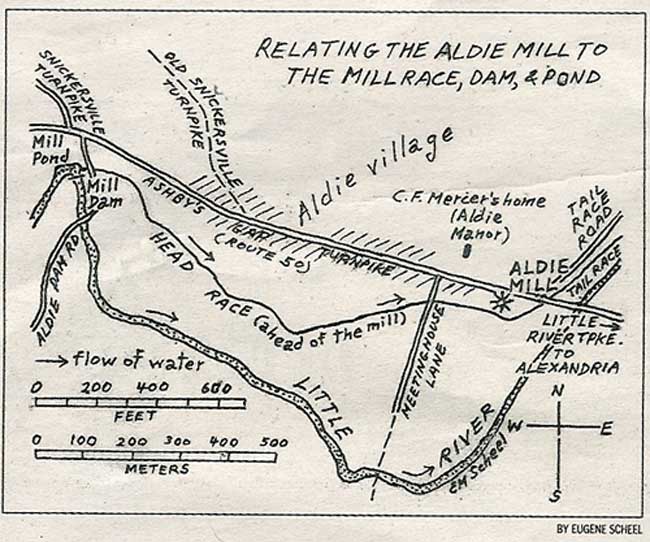
Map of the Aldie region drawn by Eugene Scheel
Map of the Aldie region, drawn by local historian and cartographer Eugene Scheel.

The Aldie Mill Historic District

The Aldie Mill is now operated by NOVA Parks as the centerpiece of Aldie Mill Historic Park. The Mill and the 108-foot-long, two-arch fieldstone Little River Turnpike Bridge are recognized by the Virginia Department of Historic Resources as essential elements of Aldie's founding identity.

The Mill Historic District is listed on the National Register of Historic Places, acknowledging its significance to Virginia's industrial and agricultural history.

Other points of interest in and around Aldie include:

The Stovepipe Academy is part of this larger tapestry of preservation—one more thread in the story of how Aldie has maintained its historical character through two centuries of change.
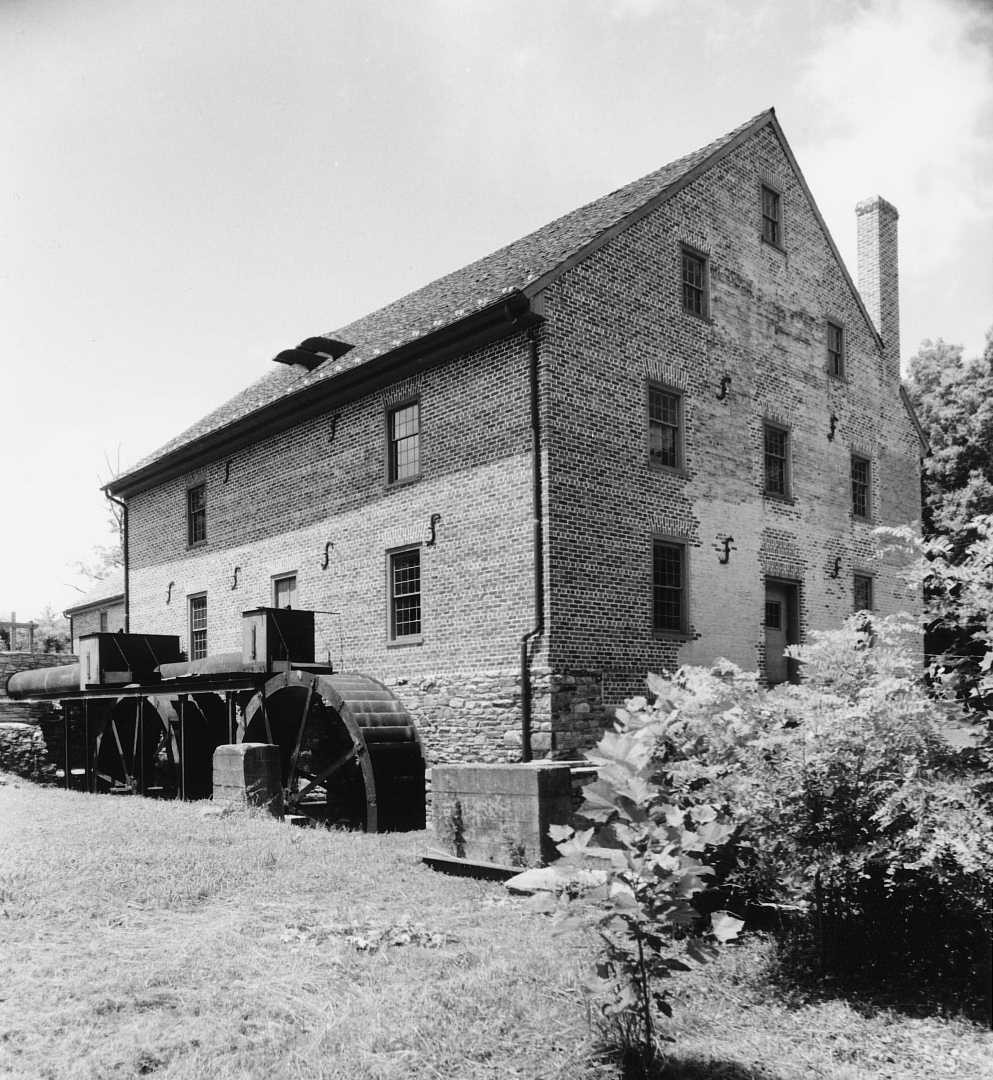
Aldie Mill powered by twin overshot water wheels
The Aldie Mill, completed in 1809, with its distinctive twin overshot water wheels. Photo credit: Virginia Department of Historic Resources, ca 1996.

Education in Reconstruction-Era Virginia

Before the Civil War, Virginia had no statewide system of free public schools. Education was reserved mostly for elite white families, and the education of enslaved and free African Americans was severely restricted and often illegal.

The Virginia Constitution of 1869, drafted during Reconstruction with participation from two dozen African American delegates, mandated the creation of a statewide public school system for all children—though the schools were tragically segregated from the outset.

William H. Ruffner, Virginia's first Superintendent of Public Instruction, oversaw the creation of the school system beginning in 1870. It was a monumental task: building schools, training teachers, establishing curriculum, and convincing communities to support public education.

Schools in this era were largely the responsibility of local parents and communities. They found or built buildings, sometimes suggested teachers, and often provided labor for repairs. School terms were short, attendance was not compulsory, and teacher salaries were low.

The Stovepipe Academy belongs to this first generation of public schoolhouses—built by and for the community of Aldie in the earliest years of free public education in Virginia. It is a physical reminder of a pivotal moment in the state's history.

A Revolutionary Change

The establishment of Virginia's public school system in 1870 was one of the most important accomplishments of Reconstruction. For the first time, all children in the state—regardless of economic status—had access to free education. It was a revolutionary change, and buildings like the Stovepipe Academy were where that promise was made real.

A Timeline of Virginia Public Education

With Aldie Stovepipe Academy Highlights — Hover over each entry for details

Before 1865

No statewide public school system exists in Virginia.

  • Education is a privilege of the wealthy, often through private academies or tutors.
  • Enslaved people are legally barred from learning to read or write.
  • In Aldie, informal schooling exists by 1858, with about 75 students attending a local village school, likely in a church or private home.

1865–1870

Post-Civil War education reform begins.

  • After the Civil War, education for freed African Americans becomes a top priority.
  • The Freedmen's Bureau begins operating schools across Virginia, including in Aldie by 1868.
  • Benjamin Allen is recorded as the teacher at the Aldie Freedmen's Bureau school.
  • These Black schools are often housed in churches or community halls and funded by Northern aid societies, the Freedmen's Bureau, and African American communities themselves.

1869

The Virginia Constitution mandates public education.

  • The Virginia Constitution of 1869, written during Reconstruction with input from African American delegates, mandates the creation of a public school system "for the education of all children of the State."
  • This is the legal birth of Virginia public education, though still racially segregated.

1870

Virginia's public school system formally begins.

  • William H. Ruffner is appointed the first Superintendent of Public Instruction.
  • Virginia's public school system formally begins operation—segregated by race.
  • Loudoun County establishes over 50 schools, including separate schools for white and Black students.

Early 1870s

The Stovepipe Academy is built in Aldie.

  • The Stovepipe Academy is constructed on Meetinghouse Lane, likely between 1870–1872.
  • Funded through proceeds from local horse meets and steeplechases.
  • The building features multiple stovepipes venting from wood stoves, inspiring its nickname.
  • It becomes School #10 in the Mercer School District, serving white children in grades 1–7.
  • Meanwhile, African American children in Aldie attend separate schools supported by the Freedmen's Bureau and later by the public "colored" school system.

1882

Miss Cecilia Warfield becomes first female principal.

  • Miss Cecilia Warfield becomes the first female principal at the Aldie school, marking a local milestone for women in educational leadership.

1888

An earlier school building in Aldie burns down.

  • An earlier school building in Aldie (possibly a predecessor to the Stovepipe Academy) burns down.
  • The two-room "academy" either survives or is rebuilt shortly after, maintaining continuity in education.

1895–96

38 students enrolled at Stovepipe Academy.

  • Surviving school records show 38 students enrolled: 12 boys and 26 girls.
  • Katie A. Russell is the named teacher that year.
  • Daily life includes walking long distances to school, learning the "three Rs," and heating the building with a central stove.

1914

The Stovepipe Academy closes after 40+ years.

  • The Stovepipe Academy closes after more than 40 years of service.
  • It is replaced by the new, larger Aldie High School and Elementary School, reflecting Virginia's move toward consolidated education.
  • That same year, the building is leased by R. L. Bodmer, who turns it into a Maxwell automobile dealership and garage.

1940

Property survey documents the former school.

  • A Loudoun County property survey documents the former school as a well-maintained shop building with electricity and stove flue added.
  • Its continued use helps preserve the structure during decades when many one-room schools are demolished.

1976

Virginia DHR surveys the historic structure.

  • The Virginia Department of Historic Resources surveys the structure as part of the Aldie Historic District.
  • It is identified as a historically significant former school building.

2022

Restoration begins under new ownership.

  • Jeanine Manley purchases the building and begins historically sensitive restoration of the interior and exterior.
  • Restoration work uncovers original chalkboards with faint 19th-century writing still preserved under plaster.

2023–2025

Museum-quality restoration completed.

  • The Stovepipe Academy is restored to museum-quality standards, including structural stabilization, discovery of blackboards, original floor plans, and period materials.
  • The building receives a Community Blue Ribbon Award from Loudoun County's Joint Architectural Review Board in 2025.
  • It becomes a centerpiece of educational heritage in Aldie, representing the legacy of Virginia's Reconstruction-era public schools.

Visiting Aldie

Aldie is located in western Loudoun County, Virginia, approximately 40 miles west of Washington, D.C. The village and its historic sites are open to visitors interested in Virginia history, architecture, and rural heritage.

For more information about visiting the area:

The Stovepipe Academy is a private property and is not currently open for public tours. This website serves as a digital archive and educational resource, making the building's history and significance accessible to all.

A Living Heritage

The preservation of buildings like the Stovepipe Academy ensures that future generations can connect with the past in tangible, meaningful ways. We hope this website helps you understand and appreciate the history that surrounds us.